Global ISO Certification Trends in 2026
ISO certification continues to play an important role in helping organizations improve quality, manage risks, strengthen information security and demonstrate compliance to customers and supply chains. In 2026, the global ISO landscape is being shaped by digital transformation, cybersecurity, sustainability, supply-chain resilience and stronger environmental expectations.
ISO's latest figures show that the organization published 1,493 ISO standards in 2025, while information technology, graphics and photography represented its largest technical sector by share of published deliverables.
For businesses operating internationally, ISO certification is increasingly becoming more than a compliance exercise. It can support operational consistency, customer confidence and access to global markets.
1. ISO Certification Trends in India
India's growing manufacturing, IT, healthcare, food, infrastructure and service sectors are creating demand for management-system certifications.
Businesses are increasingly considering:
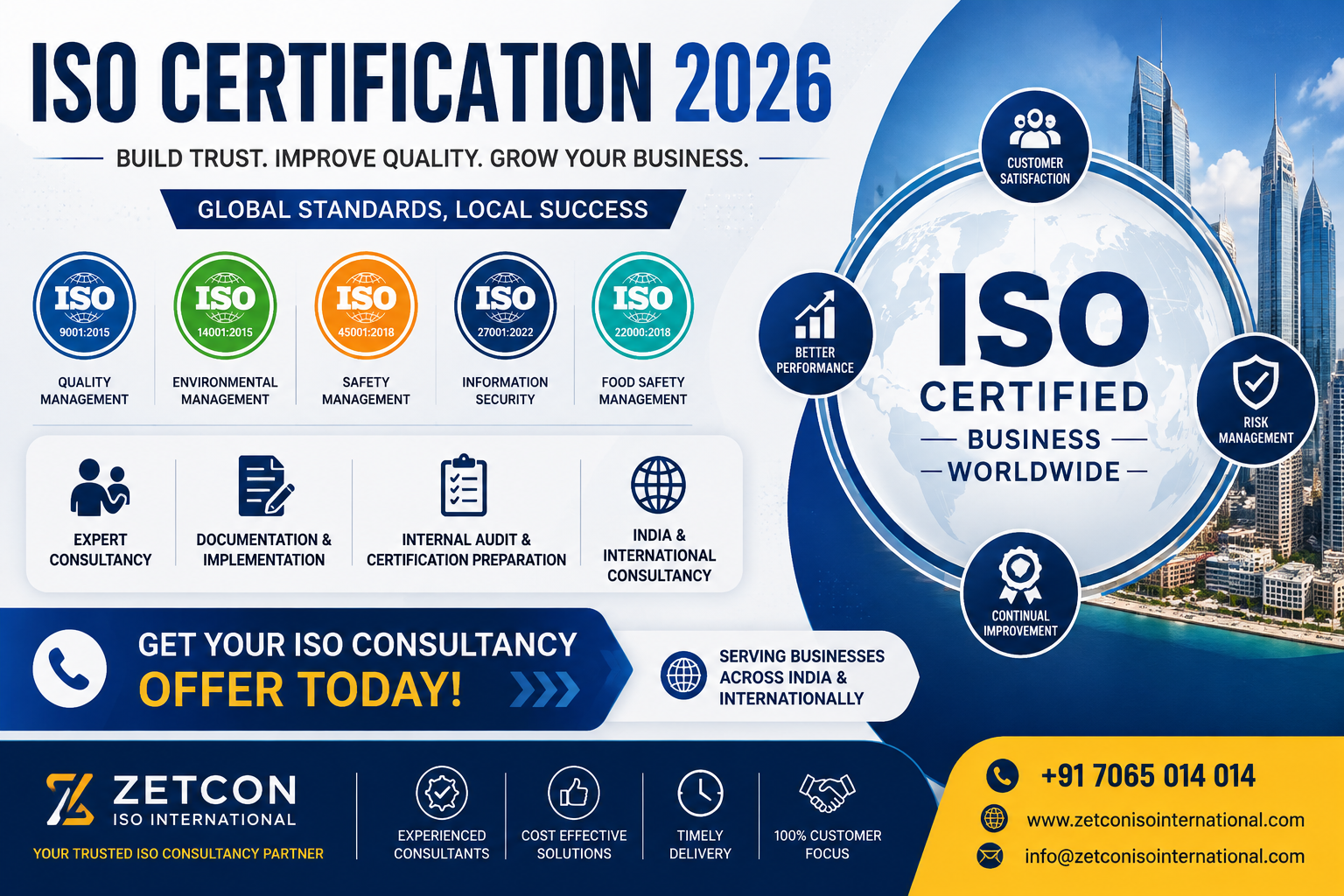
- ISO 9001 for quality management
- ISO 14001 for environmental management
- ISO 45001 for occupational health and safety
- ISO 27001 for information security
- ISO 22000 for food safety
- ISO 13485 for medical devices
For Indian companies working with international customers, ISO certification can also strengthen supplier qualification and demonstrate structured business processes.
2. ISO Certification Trends in the UAE
The UAE continues to emphasize quality, sustainability, digital transformation and internationally recognized business practices.
Organizations in construction, logistics, healthcare, hospitality, manufacturing, technology and professional services can benefit from standards such as ISO 9001, ISO 14001, ISO 45001 and ISO 27001.
Cybersecurity and information governance are particularly important as businesses become increasingly dependent on cloud services, digital platforms and connected systems.
3. ISO Certification Trends in Saudi Arabia
Saudi Arabia's economic diversification and large-scale development projects are increasing the importance of quality, safety, environmental and risk-management systems.
Companies working in construction, engineering, manufacturing, oil and gas, logistics, healthcare and technology may pursue certifications such as ISO 9001, ISO 14001, ISO 45001 and ISO 27001.
ISO certification can help organizations establish documented processes, monitor performance and demonstrate their commitment to internationally recognized management practices.
4. ISO Certification Trends in Canada
Canadian organizations are increasingly focused on quality, environmental responsibility, cybersecurity and business resilience.
ISO 9001 remains relevant for organizations seeking consistent quality-management processes, while ISO 14001 can support structured environmental management. Technology and data-driven organizations may also consider ISO 27001 to strengthen their information-security management systems.
The sustainability trend is particularly significant. ISO published ISO 14001:2026 in April 2026, replacing ISO 14001:2015. The new edition places stronger emphasis on environmental performance, leadership, governance and value-chain considerations.
5. ISO Certification Trends Across Europe
European organizations are facing increasing expectations around sustainability, cybersecurity, supply chains and corporate responsibility.
This is creating strong relevance for standards covering:
- Quality management
- Environmental management
- Information security
- Occupational health and safety
- Energy management
- Business continuity
- Food safety
For companies participating in international supply chains, maintaining documented and measurable management systems can be an important competitive advantage.
Major ISO Trends to Watch in 2026
🌱 1. Sustainability and Environmental Management
One of the biggest developments in 2026 is the release of ISO 14001:2026. ISO describes the new edition as a refinement of the established environmental-management framework, with clearer guidance and stronger alignment with current environmental priorities.
Businesses should therefore pay greater attention to environmental performance, resource efficiency, climate-related risks and measurable improvement.
🔐 2. Cybersecurity and Information Security
As organizations increasingly rely on cloud platforms, AI, remote working and digital infrastructure, information-security management is becoming a strategic business issue.
ISO 27001 can help organizations establish a structured information-security management system based on risk management and continual improvement.
🤖 3. AI and Digital Transformation
Artificial intelligence is changing how organizations operate. Businesses are increasingly looking at governance, data protection, security, risk management and responsible use of technology.
This makes the relationship between AI governance, cybersecurity, privacy and ISO management systems an important area to watch.
🔗 4. Supply-Chain Resilience
Global disruptions have highlighted the importance of reliable suppliers and resilient operations. Companies are increasingly evaluating suppliers based on quality, security, environmental and operational requirements.
ISO-certified management systems can help organizations demonstrate that their processes are structured and controlled.
📊 5. Integrated Management Systems
Instead of managing each certification independently, many organizations are moving toward integrated systems.
For example, a business may combine:
ISO 9001 + ISO 14001 + ISO 45001 + ISO 27001
An integrated approach can reduce duplicated documentation, simplify internal audits and create a more coordinated management framework.
What Should Businesses Do in 2026?
Organizations planning ISO certification should first identify their business risks, customer requirements, industry expectations and applicable regulations.
A practical approach is:
- Identify the most relevant ISO standard.
- Conduct a gap assessment.
- Develop or improve the management system.
- Train employees.
- Implement documented processes.
- Conduct internal audits.
- Complete management review.
- Select an appropriate independent certification body.
- Complete the certification audit.
- Continue monitoring and improving the system.
It is also important to distinguish ISO implementation/consultancy from certification. ISO itself does not perform certification; certification is carried out by independent certification bodies.
Comments 0